



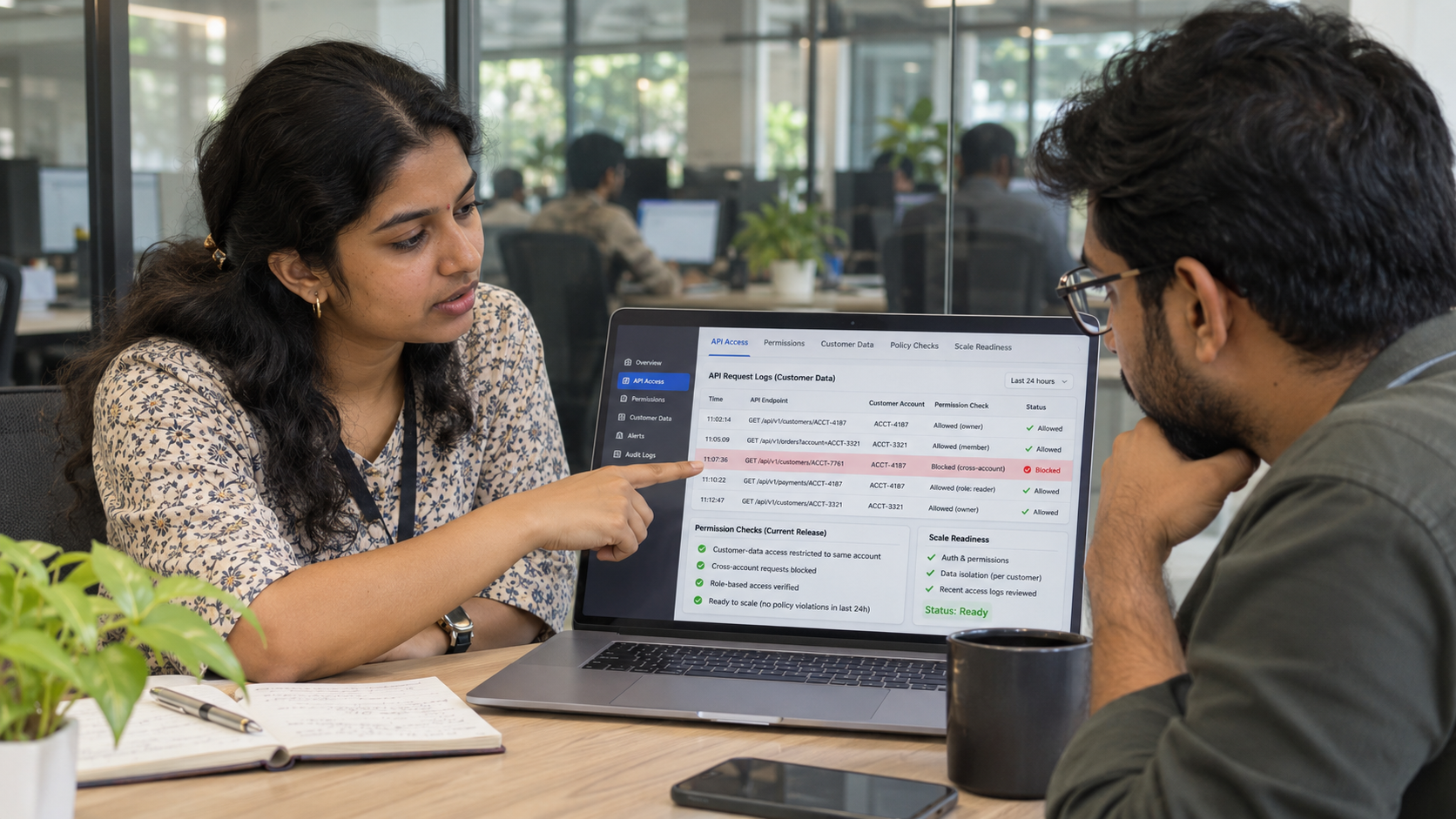

The customer portal has been running smoothly for several months. Clients can check their orders, download invoices and follow pending requests without calling the support team. Employees appreciate having everything in one place, and management is preparing to introduce the application to more customers.
As the business expands, the development team adds new connections. A mobile application retrieves order information, a reporting system collects transaction data, and external partners can check selected shipment details. Each addition solves a genuine business problem, so the project appears to be moving in the right direction.
Then a routine security test reveals something unexpected.
A user logged in under one customer account can retrieve an invoice belonging to another company. The login is valid, the application responds normally, and nothing on the screen suggests that the request should have been blocked.
The system knows who the user is. What it hasn't properly checked is whether that person should be allowed to access the requested invoice.
For a business preparing its application for wider use, this is more than a technical defect. It raises questions about customer-data separation, the permissions shared across connected systems and whether similar weaknesses exist elsewhere.
Secure web app development requires more than working login screens and encrypted connections. Every important API must verify who is making a request, what information or actions that person may access, and how the application responds when something goes wrong.
The following example shows how to investigate these risks and decide what needs attention before an application grows.
The Portal Was Working. So Where Did Security Fail?
The invoice problem was discovered through an API, the software interface used by the web application to request information from its backend.
When a customer opens an invoice, the browser sends a request to retrieve the relevant record. The backend identifies the invoice and returns the information needed to display it.
This works well when the request comes from someone authorized to view that invoice.
The problem appears when the system checks only whether the customer is logged in.
In the hypothetical portal, the backend confirms that the user has a valid session but fails to establish whether the invoice belongs to the user's company.
Changing the requested invoice identifier is enough to expose another customer's information.
The issue isn't that the API exists. The failure lies in the permission check surrounding the requested record.
OWASP identifies this class of weakness as Broken Object Level Authorization in its API Security Top 10.
For businesses operating customer portals, subscription applications or other shared business platforms, this distinction matters because different organizations may use the same infrastructure while their information must remain appropriately separated.
Authentication and Authorization Are Not the Same
Authentication establishes the identity associated with a request. Authorization determines whether that identity is allowed to access the requested information or perform the requested action.
A customer may be authenticated successfully without having permission to view every record in the application.
The correct test therefore needs to go beyond checking whether a user can log in.
A developer should verify that someone from Company A cannot retrieve Company B's invoices, orders or other protected records, even when the user supplies a valid record identifier.
The same principle applies to actions. Someone authorized to view an invoice may not be permitted to change its amount, payment status or customer details.
These restrictions must be enforced by the backend. Hiding an Edit button in the browser doesn't provide adequate protection if the underlying API still accepts unauthorized changes.
Adding More APIs Changes Who Can Reach Your Data
Before the business expanded the portal, customers accessed most features through one web interface.
Now, the same information may be requested by a mobile application, reporting software and external partners.
Each connection has a different purpose.
The mobile application may need to retrieve order status. A reporting system might require summarized transaction information, while a delivery partner needs shipment details for a particular order.
None of those systems automatically needs access to every customer record.
This creates an important architectural decision: which application or user is allowed to perform each operation, and which records should be available to them?
Consider the reporting integration. Its purpose is to create business summaries, not modify invoices. Granting it broad administrative access simply because that makes integration easier creates unnecessary exposure.
The development team should instead define the smallest set of permissions that allows the integration to perform its intended task.
This approach is commonly called the principle of least privilege.
It also applies to employees. A support executive may need to view a customer's order but should not automatically receive permission to edit financial records or export an entire customer database.
As more systems connect, those distinctions become increasingly important.
A Valid Access Token Doesn't Give Someone Permission to Do Everything
Many web applications use access tokens to identify requests made by users or connected systems.
A token can establish information about the caller and may represent particular permissions or scopes. However, a valid token doesn't automatically authorize every action.
Suppose the reporting integration receives permission to read approved transaction summaries.
If that same token can be used to modify customer accounts, the access granted is broader than the integration needs.
The development team must also verify that tokens are genuine and intended for the receiving application.
For JWT-based authentication, validation can include checking the signature, issuer, audience, expiry and applicable claims. Other token formats may require different verification mechanisms.
The OWASP REST Security Cheat Sheet explains relevant API authentication and authorization practices.
The Permission Check Must Happen Where the Action Is Enforced
Imagine that Company A's account manager requests invoice INV-2048.
The backend needs to establish the user's identity and verify that the invoice belongs to an account the user is authorized to access.
Only then should it return the permitted invoice information.
This requires a server-side check against trusted account and ownership information. The application shouldn't rely on a company identifier supplied by the browser as proof of access.
For example, changing a request parameter from company=A to company=B must not allow the user to access Company B's records.
A successful authorization design makes the business rule enforceable regardless of whether the request comes from the website, mobile application or another client.
The Next Discovery: Nobody Owns Every API
The investigation uncovers another problem.
The customer portal has grown through several development releases. Some APIs were introduced for the original website, others for mobile features, and a few exist solely to support external integrations.
Different teams maintain different endpoints.
The security team discovers that one older reporting API is still available even though the feature that originally used it has been replaced.
This doesn't automatically mean the endpoint is vulnerable. It does mean the business needs to understand why it remains active, who owns it and which permissions protect it.
An API inventory should identify both current and older interfaces, including their purpose, owner, consumers, authentication mechanism and access restrictions.
Without this information, developers may test the newest application features while overlooking older interfaces that remain reachable.
Give Every Important API a Clear Owner
The portal's API inventory might contain records like these:
| API or integration | Information handled | Responsible owner | Key access restriction |
|---|---|---|---|
| Customer invoice API | Invoice and billing information | Application engineering | Customer-account ownership |
| Order status API | Orders and delivery status | Operations engineering | Customer and partner scope |
| Reporting API | Transaction summaries | Data engineering | Approved reporting permissions |
| Payment integration | Payment references and status | Payments engineering | Restricted payment operations |
| Shipping partner API | Shipment and delivery details | Integration team | Partner-specific records |
This is an illustrative ownership model. Actual responsibilities depend on the organization's architecture.
The benefit is that every significant connection can be linked to the team responsible for maintaining its controls.
It also makes security reviews more focused. When a permission weakness is discovered, the team can identify related endpoints that may rely on the same flawed implementation.
Third-Party Integrations Need More Than an API Key
The portal relies on a payment provider and a shipping partner. Both integrations are useful, but they introduce additional responsibilities.
The shipping partner needs selected delivery information. It doesn't need access to the customer's full billing history.
The payment provider may send transaction updates, but those incoming messages must be verified before the application changes an order's financial status.
A third-party integration should therefore be reviewed in two directions: what the business sends to the provider and what it accepts in return.
The development team needs to identify which information is necessary, which permissions the provider receives and how the application behaves when an external service fails.
For integrations using webhooks, the receiving system should verify message authenticity using the provider's documented mechanism and handle duplicate delivery safely.
A webhook reporting that a payment succeeded shouldn't be accepted as genuine merely because it contains a recognizable transaction identifier.
The application must also validate external responses. Information retrieved from another system shouldn't automatically override trusted business records without appropriate checks.
OWASP includes unsafe consumption of APIs among its published API security risks, reflecting the need to treat external integrations as security boundaries rather than automatically trusted connections.
API Keys and Secrets Shouldn't Be Exposed Through the Website
During the review, developers notice that an integration credential has been included in a configuration file shared across several environments.
It was originally added to speed up testing.
As the application grew, that temporary arrangement was never corrected.
A sensitive API credential can become a serious problem if it is exposed through browser-delivered code, shared repositories or widely accessible configuration files.
Credentials used for backend integrations should remain in trusted server-side environments and be managed through suitable access controls.
The development team should know how credentials are issued, stored, rotated and revoked.
It should also consider what happens when an employee leaves, a development environment is retired or a third-party provider reports a credential compromise.
Separating development, testing and production access reduces the chance that a convenient test configuration exposes live business information.
This is a practical part of maintaining an expanding web application, not merely a concern for large enterprises.
More API Traffic Can Create Security and Availability Problems
The portal's reporting feature allows customers to download transaction information.
Initially, only a handful of customers use it.
After the business introduces the application to more users, a reporting integration begins submitting repeated requests for large exports.
Every request is authenticated, but the combined workload places considerable pressure on the database.
The issue isn't necessarily malicious activity. The integration may simply be retrying too frequently or requesting more information than the system was designed to provide.
Either way, other customers begin experiencing delays.
API security includes controlling excessive resource consumption because valid requests can still exhaust processing capacity, memory, storage or database connections.
Rate Limits Should Reflect the Work Being Performed
A simple request to check an order's status requires fewer resources than generating a report containing several years of transactions.
Applying the same rate limit to both endpoints may therefore be ineffective.
The reporting service may need controls on export size, concurrent jobs, processing duration and repeated requests.
For expensive operations, the application may be better designed to create a background job and return the result when processing finishes.
These decisions support security and operational availability together.
For a startup preparing a web application for production growth, it is worth testing these conditions before thousands of customers begin relying on the platform.
A system that works well with a small test group may still need architectural changes to handle increasing integration traffic safely.
Logging Should Help Investigate Problems Without Exposing Customer Details
Once the invoice-access problem is identified, the business needs to understand whether the same weakness affected other requests.
That requires useful application logs.
A security event should provide enough context to identify the relevant API, authenticated account, operation, outcome and request reference.
However, recording complete passwords, access tokens or unnecessary customer information creates additional security and privacy risks.
The OWASP Logging Cheat Sheet recommends appropriate security-event logging while protecting sensitive information.
For the customer portal, an authorization failure record could identify the account involved, the requested operation and the outcome without copying the entire invoice into the log.
Consistent request identifiers can also help trace an operation across the portal, internal services and external integrations.
That evidence becomes useful when a problem cannot be reproduced easily or when several systems produce different results.
Logging is most valuable when it helps the engineering team answer what happened and where the failure occurred.
It should not become another uncontrolled store of sensitive business information.
The API Security Readiness Checklist
The investigation has identified several issues. The next decision is which controls must be verified before the application can safely expand.
A useful assessment should produce test evidence, not merely confirm that a security feature exists.
The following checklist can help founders, CTOs, product managers and development teams review an API-driven web application.
| Security requirement | Practical test | Expected outcome |
|---|---|---|
| Customer-data separation | Company A user requests Company B's invoice | Unauthorized access is denied |
| Role permissions | Ordinary user attempts an administrative update | Operation is rejected |
| Authentication | Submit requests with missing or invalid credentials | Protected API rejects the request |
| Token validation | Use an expired or incorrectly scoped token | Request is rejected appropriately |
| Sensitive data exposure | Inspect API responses for unnecessary fields | Only permitted information is returned |
| API ownership | Review active and obsolete endpoints | Every relevant endpoint has an owner and status |
| Secret management | Inspect deployment and frontend configuration | Sensitive credentials are not exposed |
| Third-party callbacks | Submit an invalid payment notification | Untrusted message cannot change payment state |
| Duplicate processing | Repeat an accepted integration event | No unintended duplicate business action |
| Resource protection | Submit excessive or expensive requests | Appropriate limits prevent uncontrolled consumption |
| Security logging | Trigger an authorization failure | Relevant event is recorded without exposing secrets |
| Release readiness | Review unresolved findings | High-risk issues block affected functionality until resolved |
This is an original planning framework for the article, informed by established security practices. It is not a certification standard or proof that a particular application is secure.
Decide Which Failures Should Block Release
Not every security finding requires the same response.
For example, an authenticated customer retrieving another company's protected invoice is a serious authorization failure. The affected feature should not be released more widely while that weakness remains unresolved.
An outdated API description may also need correction, but its immediate operational impact could be different if the underlying endpoint is already properly secured.
The development team should assess findings according to potential data exposure, unauthorized actions, likelihood of misuse and business impact.
The review should record the expected behaviour, actual result, corrective action and evidence that the fix has passed testing.
That makes the checklist useful during development rather than something completed after the application has already gone live.
Fix the Weakness Before Deciding to Rebuild the Application
Finding an authorization flaw doesn't automatically mean the entire web application must be replaced.
In the customer portal, the immediate issue may be a missing ownership check in the invoice API.
A focused fix could correct the authorization logic and add regression tests across related endpoints.
However, the team needs to investigate whether the same security model is used elsewhere.
If several services independently implement inconsistent permissions, a broader architecture review may be necessary.
The decision should be based on the underlying cause, not the age of the application or the number of APIs it exposes.
Aquarious's article on diagnosing application problems before deciding on a rebuild discusses the wider distinction between targeted improvements and replacing an existing web application.
For security-related problems, the immediate priority is to contain any exposure, establish the scope of the weakness and verify an appropriate correction.
A redevelopment decision can then be considered against the application's longer-term requirements.
What Secure API Design Means for Custom Web App Development
As a business application expands, the development team needs to consider more than new screens and integrations.
The architecture must support different user roles, customer-specific access rules, trusted connections and security controls that remain effective as more people use the system.
These are important considerations in custom web app development, particularly when applications handle customer records or connect several business processes.
A web application development agency should be able to explain how its team designs permissions, validates access tokens, protects integration credentials and tests APIs before production release.
For organizations evaluating secure, API-driven web application development, Aquarious Technology's web app development services provide a relevant starting point for discussing custom application architecture, integration requirements and production-readiness planning.
The most useful first step is to document the application's critical APIs, identify who may access each operation and agree on the security tests that must pass before release.
That creates a clearer basis for development decisions than assuming that a successful login test means the application is secure.
Frequently Asked Questions About Secure Web App Development
Businesses should begin with an inventory of their APIs, the information each handles and the users or systems authorized to access it. Testing should verify authentication, record-level permissions, restricted actions, token validation, third-party integrations and resource limits. Important findings should be resolved before production release, with independent security testing considered where the application's risk warrants it.
Security requirements depend on the application's functions and the information it processes. Common controls include appropriate authentication, server-side authorization, secure credential management, input validation, encrypted communications, resource restrictions, audit logging and dependency maintenance. These controls should be planned during development and verified through testing rather than added only after launch.
Often, yes. Some weaknesses can be addressed through focused changes to permission checks, authentication, API configuration or integration controls. More extensive architectural work may be needed when several services depend on an inconsistent or outdated security model. The development team should assess the root cause and test the proposed corrections before deciding whether redevelopment is necessary.
A business should ask how the agency protects customer information, enforces user permissions, manages integration credentials and tests unauthorized requests. It should also ask how security findings are documented, which failures block release and who is responsible for maintenance after deployment. A practical demonstration of these controls is more useful than a general assurance that an application is secure.
Yes. Expanding a web application introduces more users, integrations and requests that must remain properly authorized and controlled. Rate limiting, resource quotas, secure authentication and monitoring can contribute to operational resilience. However, application scalability also depends on architecture, databases, infrastructure and performance engineering, so API security alone cannot establish overall scalability.
A Growing Web App Needs Stronger Controls, Not Just More Connections
The customer portal became more useful as it connected to mobile software, reporting tools and external services.
Those improvements also exposed weaknesses that had been less visible when the application supported fewer users and simpler workflows.
The invoice-access issue wasn't caused by using APIs. It resulted from an authorization rule that failed to check whether the requested record belonged to the caller's organization.
Once the team understands that failure, it can evaluate similar risks across the wider application.
Secure web app development depends on making identity, permissions, credentials, integrations and monitoring part of the application architecture.
For a business planning to scale, that work is just as important as developing new features.
Before expanding an API-driven web application, the development team should be able to demonstrate that users can access only the information and actions intended for them, that connected systems have appropriate permissions, and that security failures can be investigated and corrected.
A practical next step is to select one important customer journey, trace every API it uses and test what happens when a valid user attempts an unauthorized action. The result can reveal more about production readiness than another successful feature demonstration.