



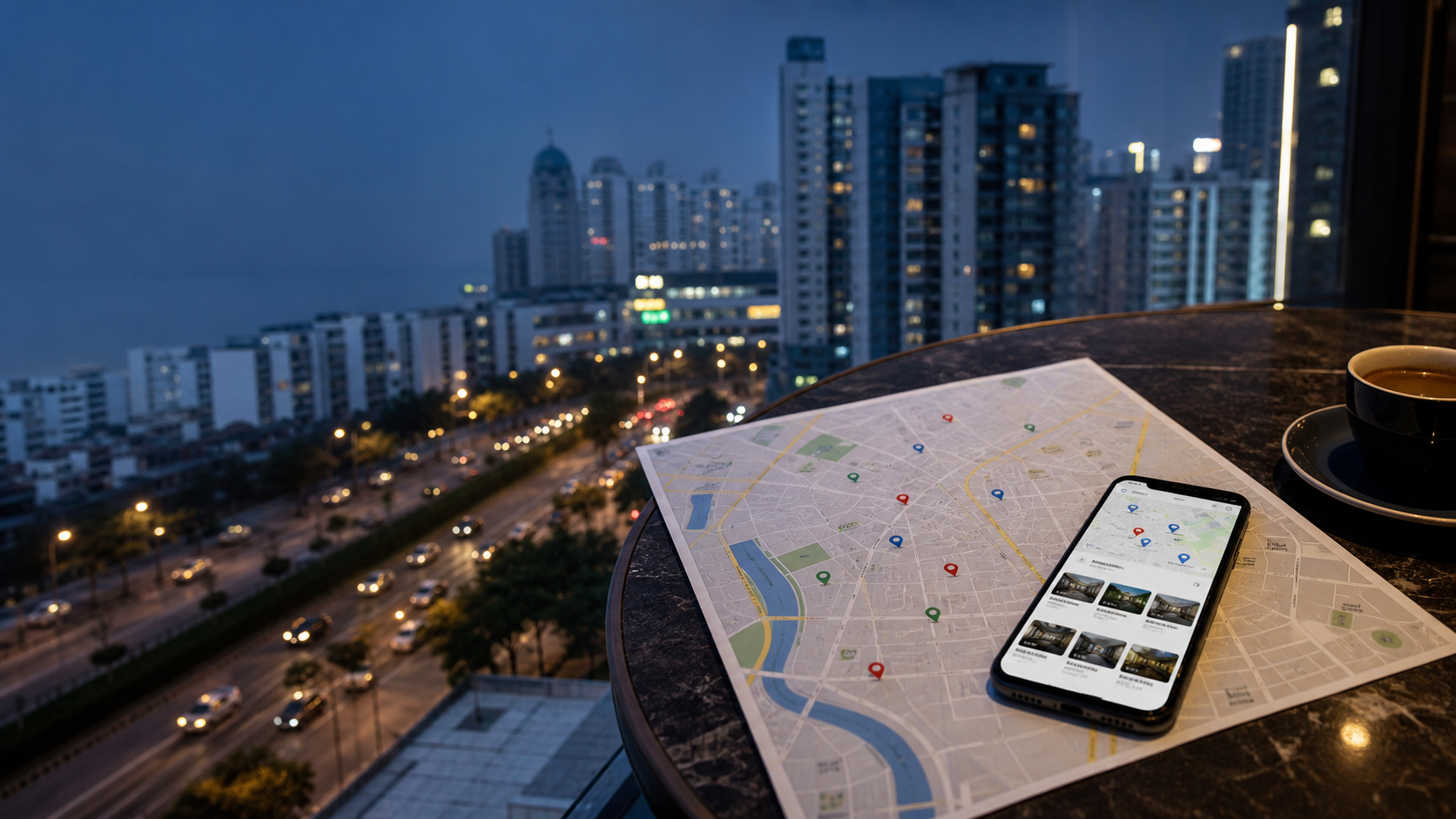

You search for your business from the office and everything looks fine. Your listing appears near the top of Google Maps.
Later, someone searches for the same service from another part of the city—and your business is nowhere near the same position.
For a local business owner, that can look like a ranking problem. Often, it is actually a location problem, a relevance problem, a competition problem—or a combination of all three.
Local search rankings can change from one neighbourhood to another because Google does not assign a business one fixed ranking across an entire city. Google says local results are mainly influenced by relevance, distance and prominence. That means a business may be highly visible close to its location but less competitive several kilometres away. Better profile information, stronger local relevance, genuine reviews and a useful website can improve your reach, but they do not remove proximity from the equation.
The Ranking Is Not Necessarily Moving. The Searcher Is.
One of the most misleading ways to check local SEO performance is to stand inside your own business, search for your main keyword and record the position you see.
That result tells you something useful—but only about that particular search from that particular location.
Google explains that distance is part of its local ranking system. If the searcher does not explicitly provide a location, Google can use available location information to estimate how far relevant businesses are from that person.
Consider a physiotherapy clinic in Salt Lake, Kolkata.
A person searching for “physiotherapist near me” from a nearby block may see the clinic prominently. Someone performing the same search from New Town may see a different set and order of businesses.
Neither result necessarily represents the clinic's “true ranking.”
A more useful question is:
Where is the clinic visible, for which searches, and where does that visibility begin to weaken?
That distinction changes how local SEO should be measured.
What Actually Determines Local Search Visibility?
Google describes three broad factors behind local results: relevance, distance and prominence.
Those terms sound simple. Diagnosing them in practice requires more care.
Relevance: Does Google Understand What You Actually Do?
Relevance is about how closely the business matches the search.
If the Salt Lake clinic specializes in sports physiotherapy but its Business Profile, service pages and website barely mention those services, Google has less explicit information connecting the business to relevant searches.
Profile categories matter here, but they should describe the real business rather than being used as a collection of keywords. Google's Business Profile guidance specifically advises businesses not to use categories merely as keywords.
Your website matters as well. A well-built service page can explain:
 what you offer;
- who the service is for;
- where it is available;
- what questions customers commonly have;
- what makes one service different from another.
That is useful for people first—and gives search systems clearer context.
Distance: How Close Is the Searcher?
Distance is the factor businesses have the least direct control over.
A company cannot legitimately optimize its way into being physically closer to every searcher in a city.
That is why a business may have excellent reviews and a strong website but still lose visibility as the search point moves farther away and closer competitors become more relevant geographically.
This is also why promises such as “we will make you number one across the whole city” should be treated carefully. Google states that there is no way to request or pay for a better organic local ranking.
Prominence: How Established Does the Business Appear?
Prominence reflects how well-known or established a business appears.
Google says signals can include information such as links to the business, reviews and ratings. More positive reviews and ratings can contribute to local ranking, although there is no universal review count that guarantees a particular position.
This is where genuine business activity matters.
A clinic that has been mentioned by relevant local organizations, attracts real customer reviews, maintains accurate business information and has a useful website creates a very different digital footprint from a profile that was created once and then ignored.
Diagnose the Pattern Before You Start “Optimizing”
Local SEO work becomes more effective when the team first identifies what kind of visibility problem exists.
| What you observe | Possible explanation | What to investigate first |
|---|---|---|
| Strong close to the business, weak farther away | Distance and stronger nearby competition | Geographic ranking pattern and competitor density |
| Weak even very close to the location | Relevance, profile quality, competition or prominence | Categories, services, profile completeness, reviews and website |
| Strong Maps visibility but weak organic rankings | Website SEO issue | Service pages, content, technical SEO and internal links |
| Good visibility but few enquiries | Conversion problem | Landing page, calls, forms, messaging and trust signals |
| One service ranks but another does not | Relevance gap | Service information on GBP and website |
| Visibility varies dramatically between similar nearby areas | Distance plus differing competitor strength | Local grid data and competitor profiles |
This is more useful than saying, “Our average ranking is five.”
An average can hide the actual problem.
A Google Business Profile Needs Maintenance, Not Just Setup
Creating a Business Profile is only the starting point.
Google recommends keeping core business information complete and accurate, including relevant location information, contact details, opening hours and other profile information.
For the physiotherapy clinic, an operational review would ask:
- Is the primary category accurate?
- Are the actual services represented clearly?
- Are opening hours current?
- Does the website link lead somewhere useful?
- Is the address correct?
- Are new reviews being acknowledged?
- Has anything changed in the business that Google or potential customers would not understand from the profile?
These are ordinary questions, but local SEO problems often begin with ordinary inconsistencies.
Service Areas Do Not Create a Ranking Radius
This causes considerable confusion for service businesses.
Google allows eligible service-area and hybrid businesses to specify areas where they serve customers. Those areas can be based on cities, postcodes or other supported geographic areas.
But setting a service area should not be interpreted as telling Google: “Rank my business equally everywhere inside this area.”
The setting describes operational coverage.
It does not eliminate distance from Google's local ranking calculations.
A plumber based in one part of Kolkata may genuinely serve customers 15 kilometres away. That does not mean the plumber should expect identical Maps visibility at both locations.
Should You Create Pages for Different Neighbourhoods?
Sometimes. Not automatically.
A useful location page should exist because the business has something meaningful to tell customers in that location.
For example, the physiotherapy clinic might have legitimate reasons to create a page around a particular service area if it can explain:
- which services are available;
- how patients from that area are served;
- relevant accessibility or appointment information;
- locally relevant customer questions;
- genuine examples or proof;
- directions or operational details where appropriate.
What it should not do is create 30 pages where the only meaningful difference is replacing “Salt Lake” with “New Town,” “Rajarhat,” “Ballygunge” or another place name.
Google's spam policies specifically warn against substantially similar pages created to rank for different regions or cities and funnel visitors toward the same destination.
Local pages need a reason to exist beyond expanding keyword coverage.
That is where people-first SEO and local SEO meet. Google's current guidance emphasizes original, useful content that provides substantial value beyond simply rewriting what already exists.
Reviews Matter, but the Way You Get Them Matters Too
Reviews can influence both customer decisions and local prominence.
The wrong response is to chase a large number of five-star reviews as quickly as possible.
The better approach is to make review collection part of the customer experience.
After a genuine appointment or completed service, a business can ask the customer for feedback and provide Google's review link or QR code. Google also encourages businesses to respond to reviews.
What businesses should not do is offer discounts, free products or other incentives in exchange for positive reviews. Google treats incentivized review activity as fake engagement and can apply restrictions to Business Profiles involved in such violations.
Authenticity beats sudden volume.
Local Rank Grids Tell a Better Story Than One Search
Return to our Salt Lake physiotherapy clinic.
Instead of checking “physiotherapist near me” from reception, imagine measuring the same query from a consistent set of points surrounding the clinic.
The pattern might show:
Very strong visibility within 1–2 km.
The clinic is clearly competitive close to its location.
Mixed visibility between 2–5 km.
Some areas remain strong; others are dominated by nearby competitors.
Weak visibility beyond 5 km.
Distance and competitive density appear to become much more influential.
That tells the SEO team considerably more than a single position.
The next step is not automatically “build more links” or “add more keywords.”
The team should compare the weak areas and ask:
- Are competitors physically closer?
- Are their profiles stronger?
- Do they have more relevant reviews?
- Are we weak for one service but not another?
- Does our website adequately explain the services people in those areas are searching for?
That is analysis. It is much more valuable than simply collecting ranking screenshots.
Local Maps Rankings and Organic Rankings Are Not the Same Thing
Another common reporting mistake is combining them into one number.
Google Maps/local results and standard organic website results are related parts of search visibility, but they are not identical ranking environments.
A business can have strong local-profile visibility and a weak website.
The reverse can also happen.
That is why local reporting should separate:
Business Profile / Maps visibility: Where the listing appears geographically for relevant local searches.
Organic website visibility: Which website pages appear for relevant queries and how those pages perform.
Google Search Console is particularly useful for the second category because it can show website query, impression, click and page-performance data. It should not be presented as a replacement for geographic Maps rank tracking.
What Should a Small Business Fix First?
Do not begin with fifty SEO tasks.
Start with the constraint that appears most likely to be suppressing visibility.
If the Business Profile is inaccurate, fix that first.
If the business ranks nearby but fades rapidly with distance, establish a geographic baseline before changing the website.
If an important service has no useful page, improve service relevance.
If location pages are thin copies of one another, consolidate or rewrite them around genuine user needs.
If visibility is strong but enquiries are weak, the problem may no longer be ranking—it may be what happens after the click.
Technical enhancements can support clearer business information as well. Google supports LocalBusiness structured data for communicating applicable details such as business information and hours, although markup should accurately reflect the visible business and should not be treated as a shortcut for local rankings.
Where Aquarious Technology Can Support the Process
For a small business, the difficult part of local SEO is rarely knowing that reviews, content and a Google Business Profile exist.
The harder part is determining which problem deserves attention first.
Aquarious Technology's approach to local SEO services for small businesses includes SEO auditing, keyword and content analysis, on-page optimization and technical SEO work. The objective should be to connect search visibility with relevant traffic and business enquiries rather than treating an isolated ranking as the final measure of success.
No provider can remove geographic competition or guarantee a fixed Maps position everywhere. A useful SEO engagement should make those limitations visible, establish measurable baselines and prioritize changes that can realistically be influenced.
Frequently Asked Questions
Google local results can change because the searcher's location affects which nearby businesses are considered most relevant. Google identifies relevance, distance and prominence as major local ranking factors. A business may therefore rank strongly around its physical location and become less visible farther away. The right diagnosis depends on whether the decline is caused mainly by distance, stronger competitors, weak relevance or insufficient prominence.
Start by improving factors you can control: accurate Business Profile information, clear service relevance, genuine reviews, useful website content and consistent business information. Then measure visibility from different geographic points. You may be able to expand your practical search footprint, but proximity remains part of Google's local ranking system, so identical rankings across an entire city should not be expected.
Not automatically. Service areas tell customers where an eligible service-area or hybrid business operates. They should represent real service coverage. Google still considers distance when determining local results, so adding an area to a Business Profile should not be treated as a mechanism for creating guaranteed visibility in that location.
Reviews can contribute to local prominence, and Google states that more reviews and positive ratings can help local ranking. They also help customers evaluate a business. However, there is no universal number of reviews required to rank. Businesses should focus on collecting genuine customer feedback consistently and avoid incentives or other practices that violate Google's fake-engagement policies.
No. Create a location page only when it provides distinct value for customers in that area. Pages that merely swap one city or neighbourhood name for another can become repetitive and unhelpful. Google specifically identifies substantially similar region- or city-targeted pages that funnel users toward the same destination as a potential form of doorway abuse.
Use more than one ranking check. Measure geographic visibility for commercially important local queries, monitor Business Profile activity, analyze website queries and pages through Search Console, and track meaningful business outcomes such as calls, qualified enquiries or bookings. The objective is not simply to move a ranking number; it is to understand whether improved search visibility is reaching the right customers.
Conclusion
If your business ranks in one neighbourhood and disappears in another, do not assume the solution is simply “more SEO.”
First identify the pattern.
Is visibility strong near your location and weaker with distance? Is one service poorly understood? Are competitors stronger in specific areas? Is the Business Profile incomplete? Or are people finding you but failing to convert after reaching the website?
Good local SEO starts with that diagnosis.
Once you know what is limiting visibility, the work becomes more focused: improve the business information, strengthen relevant service content, earn genuine customer feedback, fix technical or website gaps, and measure geographic performance consistently.
For businesses that need help turning those observations into a practical search strategy, Aquarious Technology can support the audit and optimization process while keeping the focus where it belongs: helping the right local customers find useful, accurate information when they actually need it.