



Building a B2B Petroleum Marketplace with Live Bidding
How Aquarious Technology designed and developed Petrolube Trade into a modern B2B trading platform where buyers and sellers can post requirements, manage listings, participate in live bidding, and operate from one centralized digital ecosystem.


Project Overview
Petrolube Trade was envisioned as more than a brochure website or static product catalog. The business needed a functioning B2B marketplace where petroleum traders could discover products, post buying requirements, participate in live bidding, track orders, and manage transactions through a single digital platform. The live website publicly emphasizes transparent petrochemical trading, unified dual-role access, advanced bidding, compliance, and a future-ready marketplace model for India.
From the product side, this was a first-of-its-kind digital operating model for the business. Earlier workflows were handled through paper records, Excel sheets, Word documents, and shared drives. Aquarious Technology transformed that fragmented workflow into a structured online marketplace with two core user concepts—buyer and seller—supported by dashboards, bidding logic, listing management, and requirement-based procurement flows.
Client Request & Goals
Replace Manual Trading Workflows with a Digital Marketplace
The first goal was to move away from offline, document-heavy processes and create a centralized platform where petroleum trade activity could happen in a more structured, visible, and scalable way.
Build a Dual-Role Trading Ecosystem
The platform needed to support both buyers and sellers, with the flexibility for users to operate through one account and switch roles without friction. The public site explicitly positions this as a unified trading experience where users can be buyers, sellers, or both from a single account.
Enable Transparent, Competitive, and Compliant Trade
The client wanted the marketplace to support product posting, requirement posting, reverse bidding, fixed pricing, negotiable pricing, and regulatory trust layers. The live website highlights reverse bidding, flexible pricing models, KYC verification, GST/PAN/Aadhaar integration, and regulatory compliance as core platform capabilities.

The Main Challenges
Digitizing a Traditionally Offline Trade Environment
Petroleum trade often runs through personal networks, phone calls, spreadsheets, and manual negotiation. Turning that into a clean digital product required strong workflow thinking, not just front-end design.
Designing for Two Different Commercial Behaviors
Buyers and sellers do not use the system in the same way. Buyers need requirement posting, quotes, bidding participation, and order tracking, while sellers need listing control, bidder visibility, sales insights, and buyer management. The product had to support both without becoming confusing. The public platform reflects this dual-role model clearly.
Making Bidding and Negotiation Feel Structured
A major product challenge was turning petroleum trading into an organized digital flow with live bidding, reverse bidding, quantity handling, quote management, and controlled negotiations rather than loose back-and-forth communication. The website’s “Advanced Bidding Engine” and buyer quote system reflect this need directly.
Balancing Enterprise Complexity with Usability
The platform had to feel premium and powerful, while still remaining intuitive enough for traders who were transitioning from paper-led or spreadsheet-led operations into digital workflows for the first time.
Our Approaches


Marketplace-First Product & UX Strategy
 Creating a premium B2B trading experience for a traditional industry
- Structuring discovery around petroleum categories like base oil, fuel oil, bitumen, solvent, lubricant, and grease
- Designing cleaner listing and requirement flows for faster participation
- Building confidence through a more organized, transparent interface
Measurable Success in Action
a) A Publicly Positioned Full-Funnel B2B Marketplace
The live platform does not present itself as a simple directory. It clearly communicates a complete trading journey including quick registration, KYC verification, browse and trade flows, secure communications, and order/portfolio tracking.
b) Strong Marketplace Feature Depth
The website publicly highlights unified buyer/seller access, reverse bidding, traditional auctions, quantity blocks, quick quote systems, smart product listings, sales dashboards, and compliance workflows - showing clear product depth beyond standard commerce functionality.
c) Visible Category-Led Trading Experience
The platform is structured around real petroleum trade categories such as Base Oil, Fuel Oil, Bitumen, Solvent, Lubricant, and Grease, making the marketplace operationally relevant to its target industry instead of overly generic.
d) Public Platform Scale Indicators
The website currently presents scale markers including 500+ verified traders, 10,000+ wide product range, 24/7 live trading, and 30+ years of experience, while the About page also references coverage across 15+ states.
Overall Impact
Technology Stack





Strategic Highlights & Key Metrics Improvements
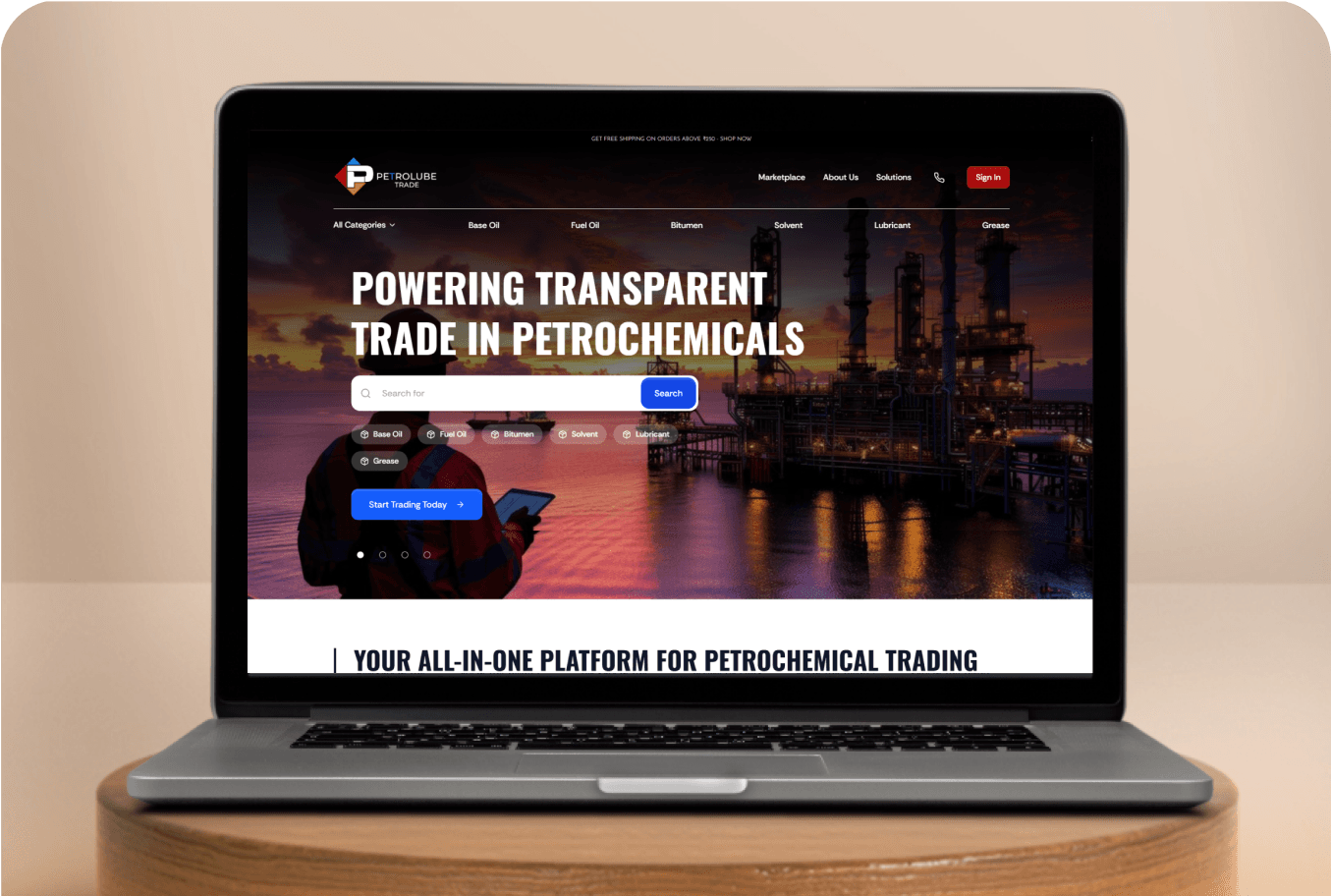
 Transformed manual trade operations into a fully digital ecosystem for high-volume transactions.
- Reduced order processing time by 60% through automated bidding and documentation workflows.
- Boosted market transparency by providing real-time data to all verified participants.